Yad Vashem has published an "Encyclopedia of Jewish Communities, Poland" and a complete chapter (Volume VII) is devoted to the history of the Jewish community in Tomaszow Lubelski. A translation of that chapter by Morris Gradel appears on the JewishGen website, click here. It is a compelling account, beginning with the promise at the end of the 16th century of personal and economic freedom by Baron Tomasz Zamojski to the Jews who settled there. The story explains how the town achieved a reputation for its Chassidic scholars, and by the beginning of the 20th century, even Zionist and Bund groups had formed.
Although there were few in the area who were were friendly towards the Jews (Yad Vashem has honored one citizen of TL as a Righteous Gentile, and the chapter reports that the local priest Julian Bogatek gave safe haven in his home to Jews), Samuel Kalb must have foreseen the nightmare that was coming. The summer of 1914 as Jennie Kalb left for America with her children, we are told "fierce battles raged around TL and a fire broke out there, destroying many houses. In the summer of 1915 the area was conquered by the Austrians and the Germans. The new authorities appointed a new Town Council under the leadership of a Jew, Yehoshua Fiszelson. The inhabitants bore a heavy tax burden, the authorities confiscated some of their property, and there was hunger in the town."
They escaped not a moment too soon. During the period between the wars the area was turbulent. While it was marked by a rise in cultural and educational activity (the Yiddish weekly paper, "Tomaszawer Wochenblatt" began publishing in 1918) but increasing anti-Semitism foreshadowed the Shoah. For the 3,500 remaining Jews of Tomaszow Lubelski, this began on September 6, 1939, when "the Germans bombarded TL, and some 150 of its inhabitants were killed. The Jewish quarters were badly damaged. The Bet Midrash and other prayer-houses went up in flames, and many of the local Jews were rendered homeless." (that explains the missing synagogue I noted in an earlier post.)
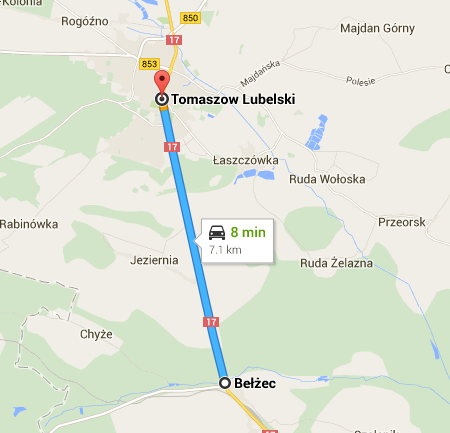
The atrocities escalated. Gestapo Officer Walter Anzer (may his name be erased) oversaw the annihilation. "The chairman of the Judenrat, Fiszelson, who refused to supply the Germans with a list of Jews to be deported, was arrested and executed together with his wife and son. . . . On October 27, 1939 the last of the Jews of TL were murdered. The Gestapo and an auxiliary force of Poles surrounded the houses of the Jews, rounded them up and despatched them to Belzec (just 7 km soouth of town). Some succeeded in escaping to the woods, but most of them were caught by Polish collaborators and delivered to the Germans. A mere handful of the survivors managed to organise resistance. Some youths who had fled in May formed a fighting unit and even managed to get hold of a few weapons. One of them, Mendel Heller, fell in battle, and two of his comrades, Szymon Goldsztein and Meir Kalechmacher, were killed by Polish anti-Semites."